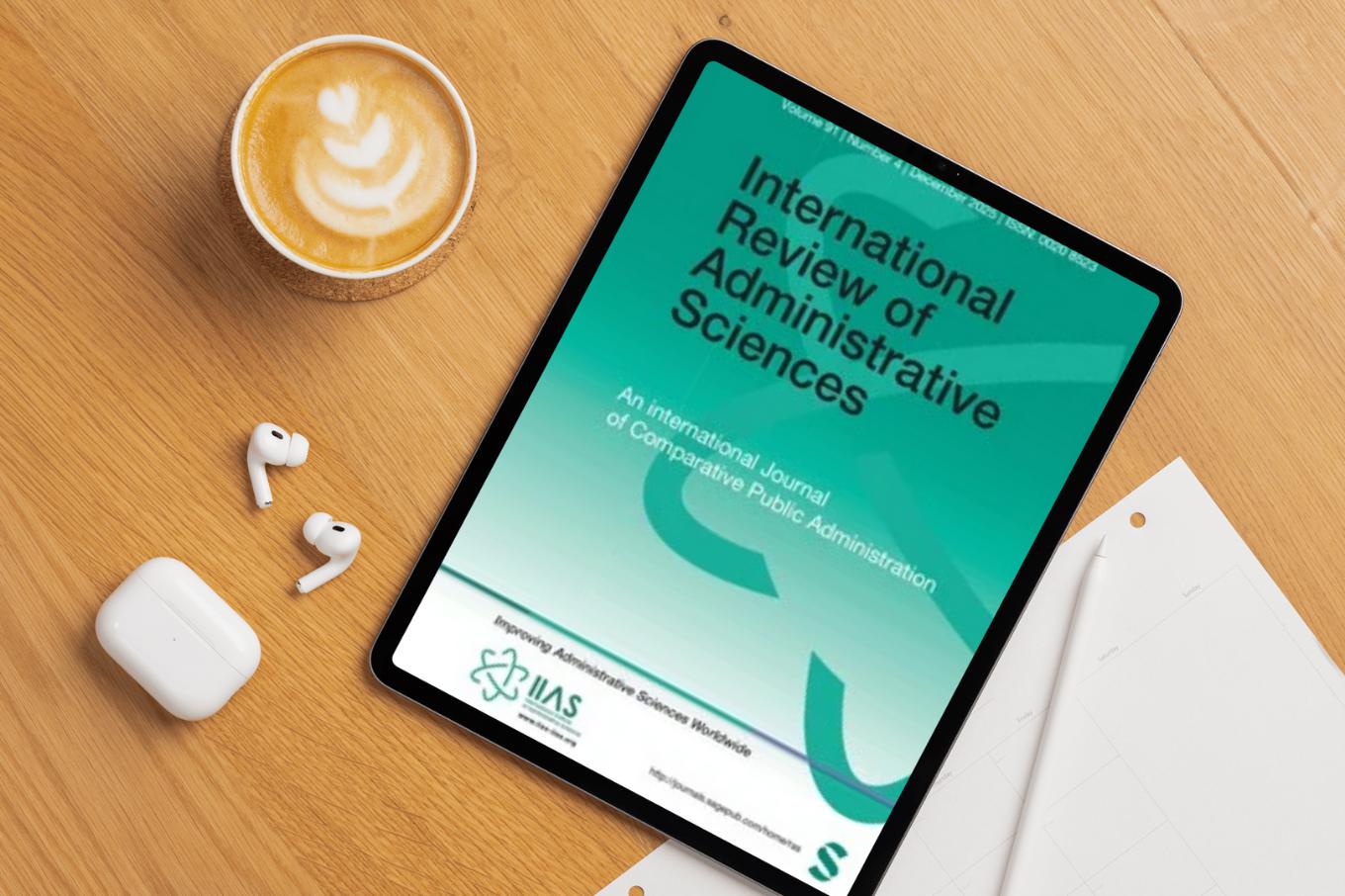
Volume 91, Issue 4 (December 2025) of the International Review of Administrative Sciences (IRAS) is now available. This new issue brings together diverse and timely research on comparative public administration, public sector reform, research methods, public-private innovation, policy outsourcing challenges, bureaucratic fairness, political appointments and the impact of fiscal policy on economic growth in emerging economies.
The issue opens with a book review by Dmytro Panchuk, discussing Comparative Public Administration, Public Sector Reforms, Administrative Traditions and Cultures by Sabine Kuhlmann, Hellmut Wollmann, and Renate Reiter.
Six peer-reviewed research articles explore critical questions in public administration:
The value of paired and longitudinal surveys in public administration research – Jacob Aars, Tobias Bach, Jarle Trondal
Unpacking the mechanisms linking public–private innovation partnership and public value creation: a configurational approach – Hong Mei, Xuemin Yang
Navigating the pitfalls of outsourcing: Policy consulting in settings with lower administrative capacity – Denitsa Marchevska, Ellen Fobé
Unfair bureaucratic encounters and willingness to coproduce public services – Youlang Zhang, Xufeng Zhu
The effect of fiscal expenditure on the economic growth of developing countries in West Africa – Guo Lei, Foday Sulaiman Bangura, Abdul Karim Kamara
Discretion of public appointments in Mexico: A review of organizational arrangements in subnational appointments – Calep Pimienta Gonzalez
Explore the new issue to stay up-to-date with the latest research on public administration and governance.
About IRAS
The International Review of Administrative Sciences (IRAS) is the flagship peer-reviewed journal of the International Institute of Administrative Sciences (IIAS). Founded in 1927, IRAS is the oldest scholarly journal dedicated specifically to comparative and international public administration. The journal advances the global conversation on public governance, encourages reflection on emerging approaches, and fosters dialogue between scholars and practitioners.

 International Review of Administrative Sciences (IRAS) -
Link
International Review of Administrative Sciences (IRAS) -
Link